Announcements
Jun 26,2023
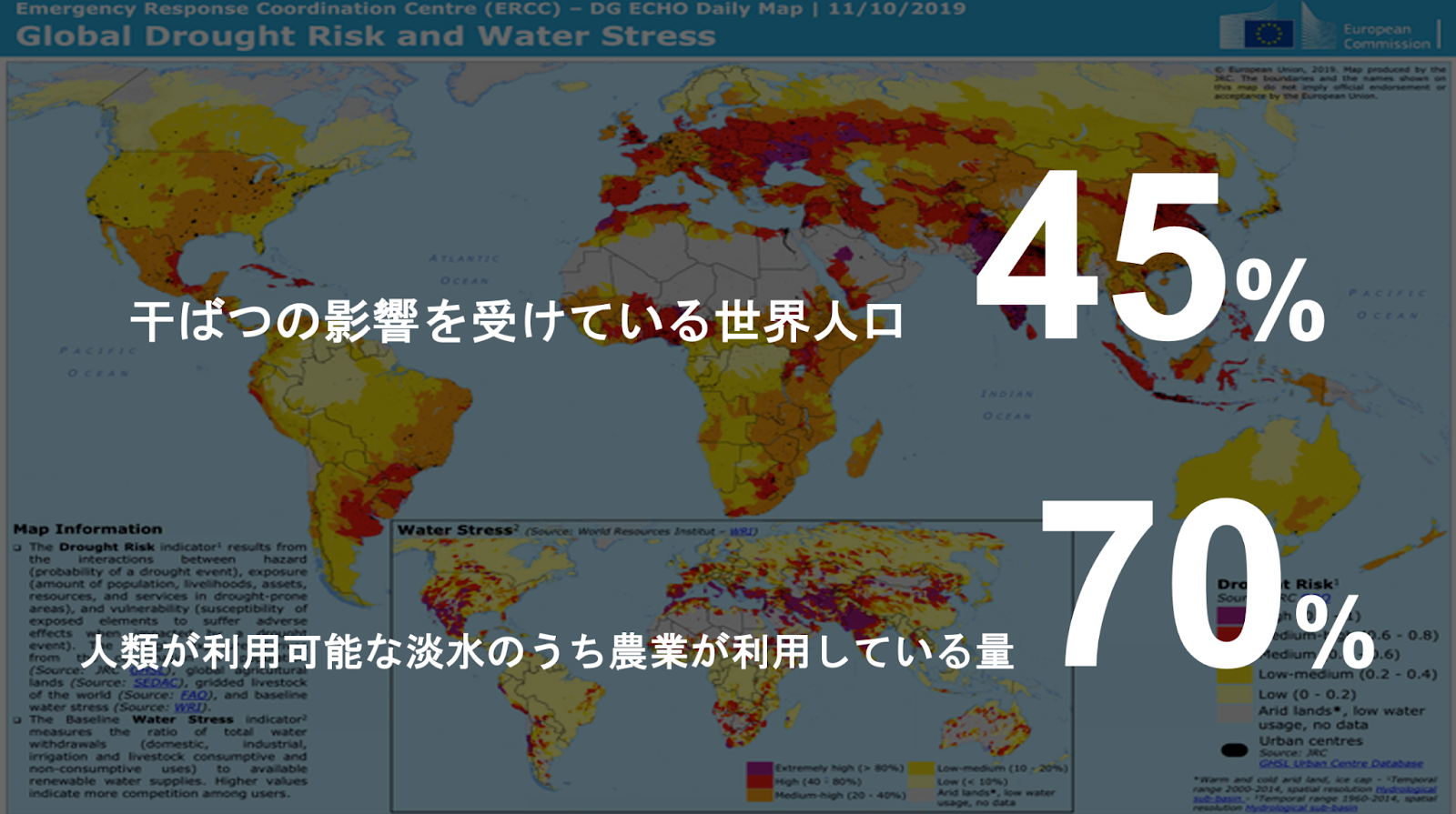
Do you know about the “water issues in agriculture” that are occurring around the world? In Japan, which is blessed with water, it is an environment where safe water comes out as a matter of course when you twist the faucet, but that is not the case overseas. Currently, the global population affected by droughts has reached 45% of the total, and the situation is getting worse year by year. Furthermore, it is said that 70% of the fresh water that can be used by humans is used by agriculture, and many farmers are facing the issue of water scarcity.
We aim to solve the problem of water scarcity in agriculture by popularizing 100% organic water-absorbing polymers. In this article, I will introduce examples of demonstration tests using EF polymers that have been conducted around the world.
Objective: Improve water retention in dry soil and check the impact on yield
Experimental method: Test is carried out by changing the amount of polymer applied and the amount of irrigation
.png)
[Results]
In EF polymer usage areas,Even if irrigation is reduced by 40%, the yield is higher than normal. By using EF polymers,Increased yield even with reduced irrigationIt was connected to
.png)
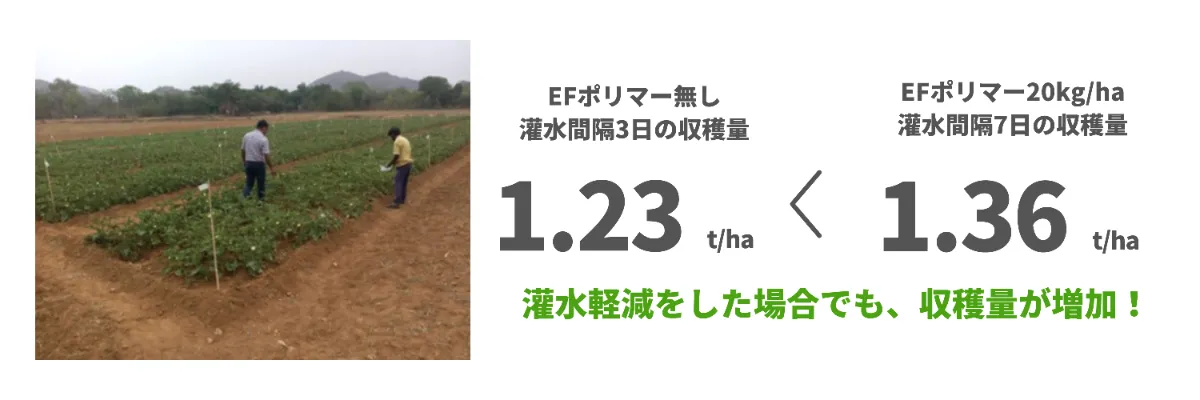
Objective: Improve water use efficiency and check the impact on crop yield
Experimental method: Test is carried out by changing the amount of polymer applied and the frequency of irrigation
[Results]
The yield of districts with EF polymers and long irrigation intervals (7 days) increased compared to districts with short irrigation intervals (3 days) without EF polymers. By applying EF polymer,Increased yield even when watering frequency is reducedIt was connected to
Objective: Check the impact on water use efficiency and fertilizer use efficiency
Experimental method: Test was carried out by changing the dosage of EF polymer and fertilizer
[Results]
As a result of carrying out tests by changing the amount of EF polymer and fertilizer used,Harvest yields have increased, particularly in regions where rainfall is low. Harvests increased by 60% in heavily affected areasThere were regions too.
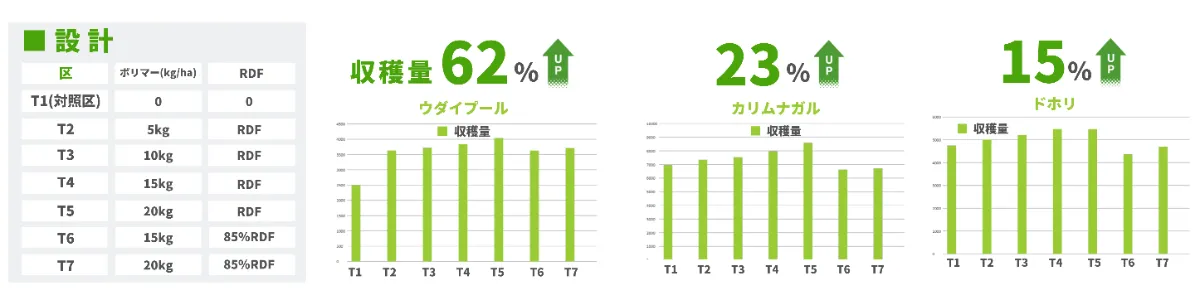
Objective: Reduce the frequency of irrigation and check the impact on crop weight
Experimental method: Apply 1,2% EF polymer to cabbage seedlings and investigate the growth of seedlings by dividing them into “normal irrigation zones” and “reduced irrigation zones.” In addition, a survey was carried out on the growth of seedlings after planting them in the field.
[Results]
・Seedlings in the “normal irrigation zone” gained 22% in the 1% plot and 18% in the 2% plot
・Seedlings in the “Irrigation Reduction Zone” increased their weight by 32% in the 1% plot and 28% in the 2% plot
.png)
Greater effect in environments where water stress is appliedI got it. Also, since EFP 1% had a higher yield than the EFP 2% zone under the conditions of this test area, it became clear that it is important that the amount to be applied is an appropriate amount (the recommended amount is 0.5% to 1.0% of the amount of soil).
If you want to know the details of the demonstration test in more detail, please see the report from the link below.
https://ja.efpolymer.com/experiment