Announcements
Sep 25,2025
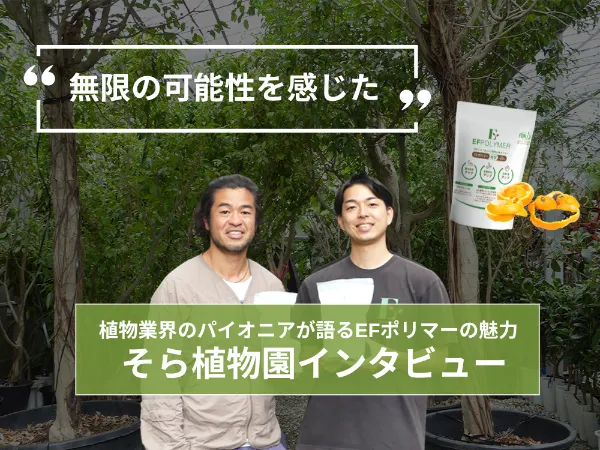
We perform everything from landscape design to construction and landscaping work for famous facilities such as GSP, Tokorozawa Sakura Town, and TORAYA GINZA“Sora Botanical Garden”As a pioneer in the plant industry, it is a company active in a wide range of activities both domestically and domestically. This time, we asked Mr. Seijun Nishihata, the representative director of “Sora Botanical Garden Co., Ltd.,” which is headquartered in Ikeda City, Osaka Prefecture, and Mr. Morishita Yuichiro from the company's nursery department about their impressions of using EF Polymer.

Mr. Nishihata: In the flower gardening industry that handles plants, there are various industries, such as producers that grow plants, wholesalers, landscaping businesses that perform landscaping work, and coordinators and designers that coordinate greens, etc., but I think “Sora Botanical Garden” because I wanted to transcend these suggestions and be an entity that can Meet demand from the public.
It is a company that invigorates plant-based jobs, and we value considering to challenge the full potential of plants. Refusing, Refusing in the EF Polymer Experiment was one of the challenges, and I was looking forward to actually being able to use EF Polymers that I had known for a long time.
Mr. Nishihata: When a businessman I know was growing to start a banana farm in Okinawa, he said he wanted to use EF Polymer, and I thought the name.
As someone handles plants, I fully appreciated the advantages of EF polymers without using them, but I was hoping that they would store too much water in order to use them in Okinawa. On the other hand, I was surprised that it would come in handy in regions with low frequency.
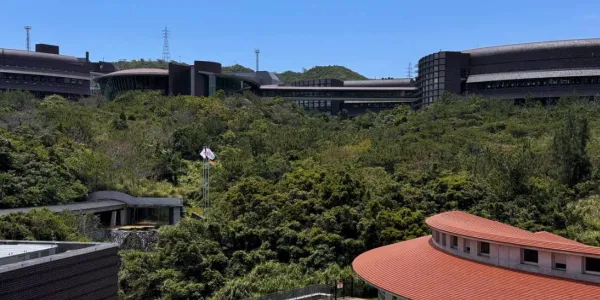
Mr. Nishihata: I have an understanding who is on good terms with EF Polymer, and I had the opportunity to visit Okinawa Institute of Science and Technology Graduate University (OIST), which is also the BASE of EF Polymers.
I was considered useful in EF Polymers, so I received an advantage of what kind of product it is, and I thought from my own experience that it might be useful in other places than Japan, and That it might be useful in the gardening world rather than agriculture.
From there, the conversation progressed at a rapid pace, and it was conducted to conduct a deliberate experiment using EF Polymer at Sora Botanical Garden.
Nishihata: The results of the experiment were as expected in a good sense. In experiments with pots, it was possible to grow plants by irrigating by more than half.
[About the experiment]
Contents and Purpose: Reduction of irrigation frequency (irrigation cost) during sapling production by using EFP polymers and growth improvement Test Varieties: 10 Varieties of Cotton Candy, Schefflera, lemon, etc.
Test method and period: Compare “EFP 1% mixed soil zone” and “district without EFP”. Irrigation is carried out at the timing of drying, based on the values of the soil moisture meters in each district. The exam period is 2024/9/12.
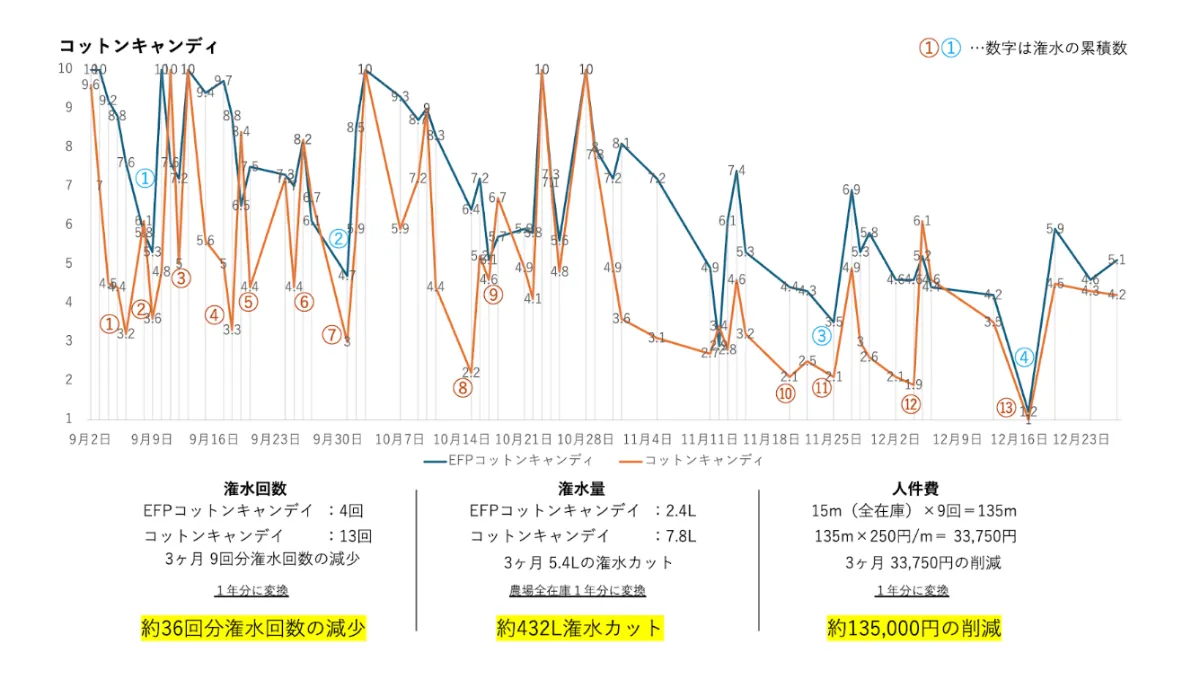
Also, plants grow by drying moisture and drying cycles. By using EF polymers, water retention moisture, and as moisture, growth would slow down by treating the wetting and drying cycles, growth has moderated slightly.
From a horticultural point of view, gentle growth is also an advantage. When doing indoor greening, choose plants suitable for indoors, but if they grow too much, they will get in the way. Even though I placed plants in the cafe, they grew too much and hit windows, got in the way of traffic lines, and the atmosphere changed when they grew up...
Greening, in indoor greening, the fact that plants grow slowly and do not change their shape is an advantage. Branches, foliage plants tend to sell better when they last longer and grow slowly, so I think EF polymers and indoor greening are very compatible.
Mr. Morishita: We examined an experiment using transparent planters, and the big difference between the differences that used EF polymer and those that did not use it how they took root. There was a growing for growing using EF polymers to root faster and more likely, and not using EF polymers tend to have less root growth.
Also, using EF Polymers was considered effective for plants from the Oceania family. Plants with High Water Stress have Improved Root Growth by using EF Polymers, and the number of shoots that sprout is also high, and the number of times they are irrigated is 1/3 or less, Which is a pretty good result.
On the other hand, it was not possible to cause results as expected for some plants that are affected to climate effects such as rain or changes in temperature. I would like to continue experimenting and find an equation for how EF polymers are compatible.
Mr. Nishihata: When growing raw plants, maintenance is always necessary, such as checking for insect outbreaks and diseases. If EF Polymers are used, for example, once a week is enough once every two weeks. I think there are quite a few advantages to using EF polymers.
Mr. Morishita: This Time, We Used Granular EF Polymers There were times when it grew gel-like as soon as it was grown on soil that was already moist.
It was great for use on plants in planters, but I would like to continue growing how to use this area, such as how to spray.
Mr. Nishihata: Plants in particular must not run out of water until they have taken root. Once eaten, they don't need that much water, but plants that have just been retreated or that have been transacted for about a year or two should always have a little bit of moisture. So, I think such plants are very compatible with EF Polymers.
Actually, when I worked on plants for the American and French pavilions at the Osaka-Kansai Expo, I used EF Polymer. Since the Expo is also a testing ground for future society, it was considered that EF Polymer would be used even before the experiment was carried out.
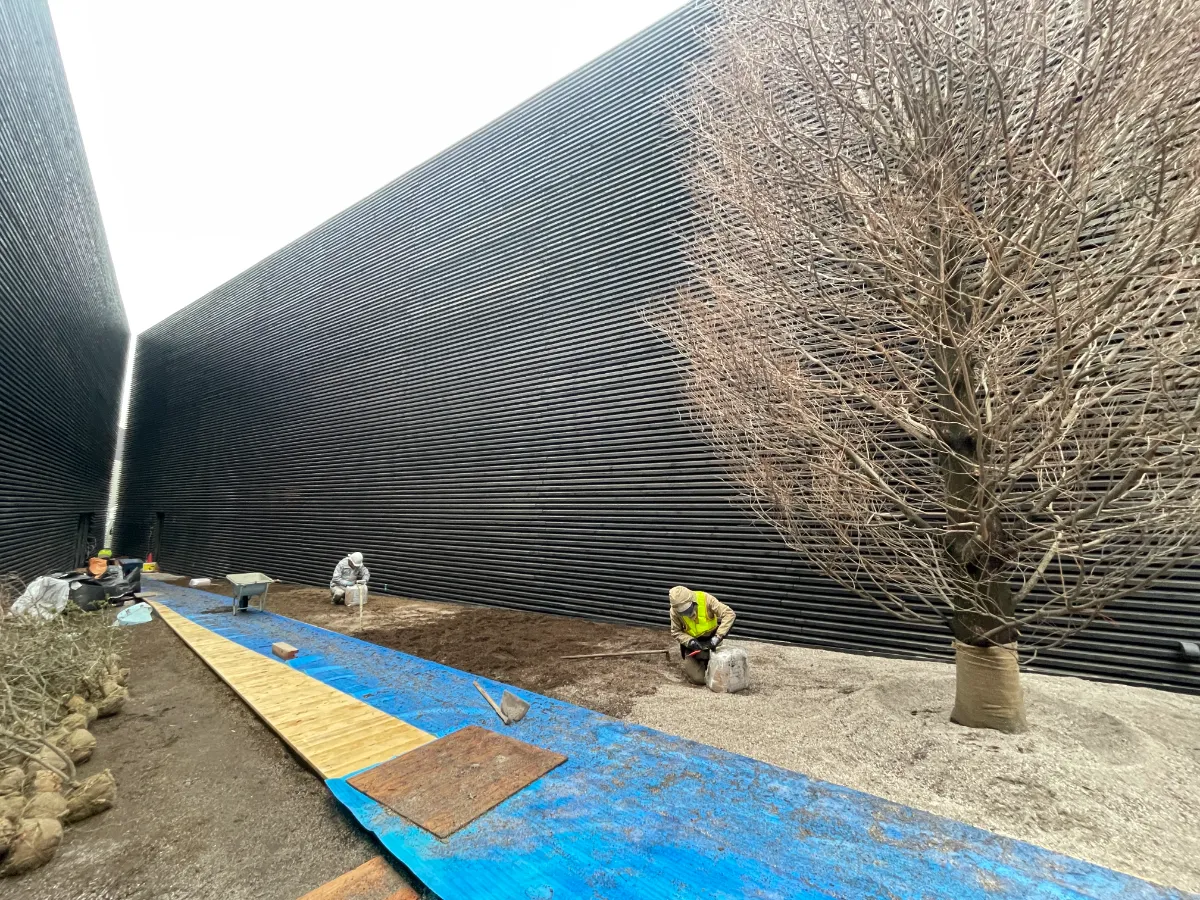
<Arrived at the Osaka-Kansai Expo American Pavilion using EF Polymer>
There is an olive tree that is said to be 1,000 years old and was considered from Southern France, which is also the centerpiece of the French pavilion, and EF polymer is used on the root Part, which is also the base part of moss. Moss moss also has high water retention properties, so it remains healthy even when almost no water is given.
Artificial substrates tend to dry out, but since EF polymers are used, plants in American pavilions can also be partially controlled the number of times they are irrigated.
Mr. Nishihata: Through this experimental experiment, I felt that the product is more suitable for the gardening industry than agriculture. EF Polymers will be effective in planters, roof greening, artificial infrastructure greening, freshly-grown plants, etc.
Confused on how you use it, I really felt that it was a pretty effective product, so I would like to continue using EF Polymer. At this stage, there are about 60 to 70 projects ahead, and we would like to use EF Polymers. In a year, it will be possible to say that not only domestic but also famous companies around the world use EF Polymers, so I think it will attract more and more attention.
Of the 1 sustainable yen industry is called the flower gardening industry, the rental green industry represents a market of about 60 to 70 billion yen. EF Polymers and indoor greening are quite compatible, so while there are few investors who are familiar with plants, I expect EF Polymer to be a product that will continue to grow if more Information is conveyed about the actual situation.
~Editorial Postscription~
When I visited Sora Botanic Garden's headquarters in this interview, there were about 10 junior high school students who came for work experience. Junior high school students are watching the interview because it was a great opportunity, and after the interview was over, Mr. Nishihata attended to the students in an understanding manner That EF Polymer is a product that is careful attention from Around the World.
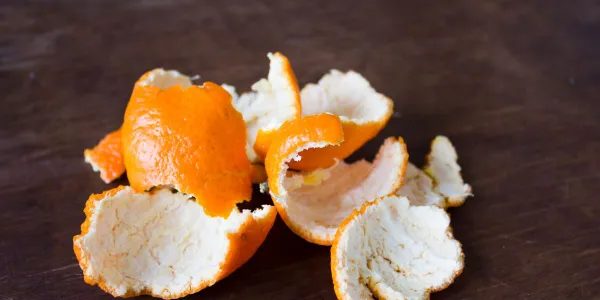
“This EF polymer is made of fruit peels, etc., and since there are no chemicals in it, it can even be harmful. Polymers up until now are made from petroleum and do not return to soil, so they become global garbage.”
“Garbage is buried in landfills, and over time it flows into the ocean, fish eat what has become microplastic, humans eat that fish, and it's a big problem for humans... that's why this Product is Attention from Around the World.”
The words of Mr. Nishihata, who conveyed my thoughts for EF Polymer and my desire to work for children living in the future.
Thank you very much for taking the time to do this.
Sora Botanical Garden official website:https://from-sora.com/
Contact EF Polymers here:https://efpolymer.jp/